Price: $39.95
Page Count: 293
Publication Date: March 2025
ISBN: 978-1-77258-533-9
Gone Feral is a compelling exploration of the untamed, the monstrous, and the transformative power of wildness as it intersects with femininity. Blending rigorous scholarship with evocative storytelling, and richly illustrated with vibrant color images, this book invites readers to not just engage intellectually but to feel the raw power of its arguments. The concept of ferality is explored across social, cultural, literary, and existential dimensions, revealing how it redefines norms around gender, motherhood, and autonomy. By turns infuriating, shocking, and profoundly moving, Gone Feral pushes the boundaries of gender studies and feminist thought. It is a bold, essential read that calls on readers to reconsider the meanings of unruliness, resistance, and liberation in a constrained and constraining world.
- Dr Veronica Frigeni, Visiting Scholar in Gender Studies, Central European University and Centre for Feminist Research, York University
Gone Feral takes an original, fresh, and convincing concept and executes it marvellously: it attends to the concept and lived experience of ferality in order to expose the consequences of being hemmed in by the restrictive idea(l)s of patriarchal domesticity. It probes notions of agency, liminality, liberation, and trauma recovery, among others. The inclusion of analytical chapters as well as artwork and genre-bending pieces makes this collection an outstanding resource not only for students and scholars but for anyone wishing to understand a so-far underexplored aspect of womanhood.
- Zsuzsanna Lénárt-Muszka, assistant professor, University of Debrecen; co-editor of the upcoming Contemporary Maternal Subjectivities on the Page and on the Screen (Sciendo-De Gruyter Brill, 2027).
Gone Feral initiates the necessary work of integrating the maternal into the contemporary movement of feral feminism. The interdisciplinary nature of the collection, including art, photography, and poetry alongside scholarship in art history, psychoanalysis, history, film studies, and literary analysis, presents readers with a rich, engaging exploration of women reclaiming wildness, challenging normative and patriarchal norms of gender and maternity, and finding expression through creative and artistic forms.
- Christa Baiada, Associate Professor of English, City University of New York
Click here to read a review fromThe Journal of International Women’s Studies
Enactments:
1. Taken by the Others – The Danger of Being Feral, Martina Cleary
2. From ‘Harlots’ to ‘Irresponsible’ Economic Citizens: Shifting Discourses on Sole
Mothers, Emily Wolfinger
3. Gone Spielreinian: Maternal Ferality and the Suprahumanities, Jessica Spring Weappa
4. Three Little Witches, Hillary Di Menna
5. Selected Poetry, Joy Domingo
6. Feral Itch, Caroline Carey
7. Mothers Born Feral, Teela Tomassetti
8. The Mess House: Wildness in the Domestic Realm, Batya Weinbaum
Representations
1. Alexandra Carter: NEED TO ADD HER INTRO SENTENCES.
2. Strike a Pose, Catherine Moeller
3. From Bold, Going Feral: Xiao Lu's Feminist Art and Ferality, Li Yang
4. Selected Poetry, Victoria Smits
5. Unfaithful Domestics: Ferality and Domestic Disorder in John McPherson's Strays
(1991), Casey O’Reilly-Conlin
6. Releasing the (m)Other within: Jeanette Winterson’s Feral Journey from Oranges Are
Not The Only Fruit to Why Be Happy When You Could Be Normal, Else Werring
7. From Pig to Dog: Becoming Woman/Becoming Mother, Laura Bissell
8. Gone Feral: Deviant Mothers, Defective Mothering, and the Undoing of Normative
Motherhood in Katixa Agirre’s Mothers Don’t and Yewande B. Omotoso’s An Unusual Grief,
Andrea O’Reilly
Edited by Casey O’Reilly-Conlin
and her mother, Andrea O’Reilly, a
professor of Gender, Sexuality & Women’s
Studies at York University, Gone Feral:
Unruly Women and the Undoing of Normative
Femininity archives the complexities of
femininities gone bad, wild, and disruptive.
The collection compiles 16 entries exploring
the concept of ferality through various
feminist activist, artistic, and scholarly lenses.
The editors reveal the project’s scale
and scope from the outset, dedicating
it to “feral women everywhere.” From
poetry, visual art, and prose to thoroughly
researched academic articles and analytic
essays on visual culture, Gone Feral collects
feminist voices resisting restrictive lives,
most notably those of maternal identities.
Split into two sections—Enactments
and Representations—the collection
offers intimate reflections on monstrous
and untamed motherhood. One example
is the painting series, “The Mother Shell,”
by Alexandra Carter, who uses feminist
theorist Barbara Creed’s concept of the
monstrous-feminine to explore fertility,
maternity, and transformation.
The editors reveal the
project’s scale at the
outset, dedicating it to
“feral women everywhere.”
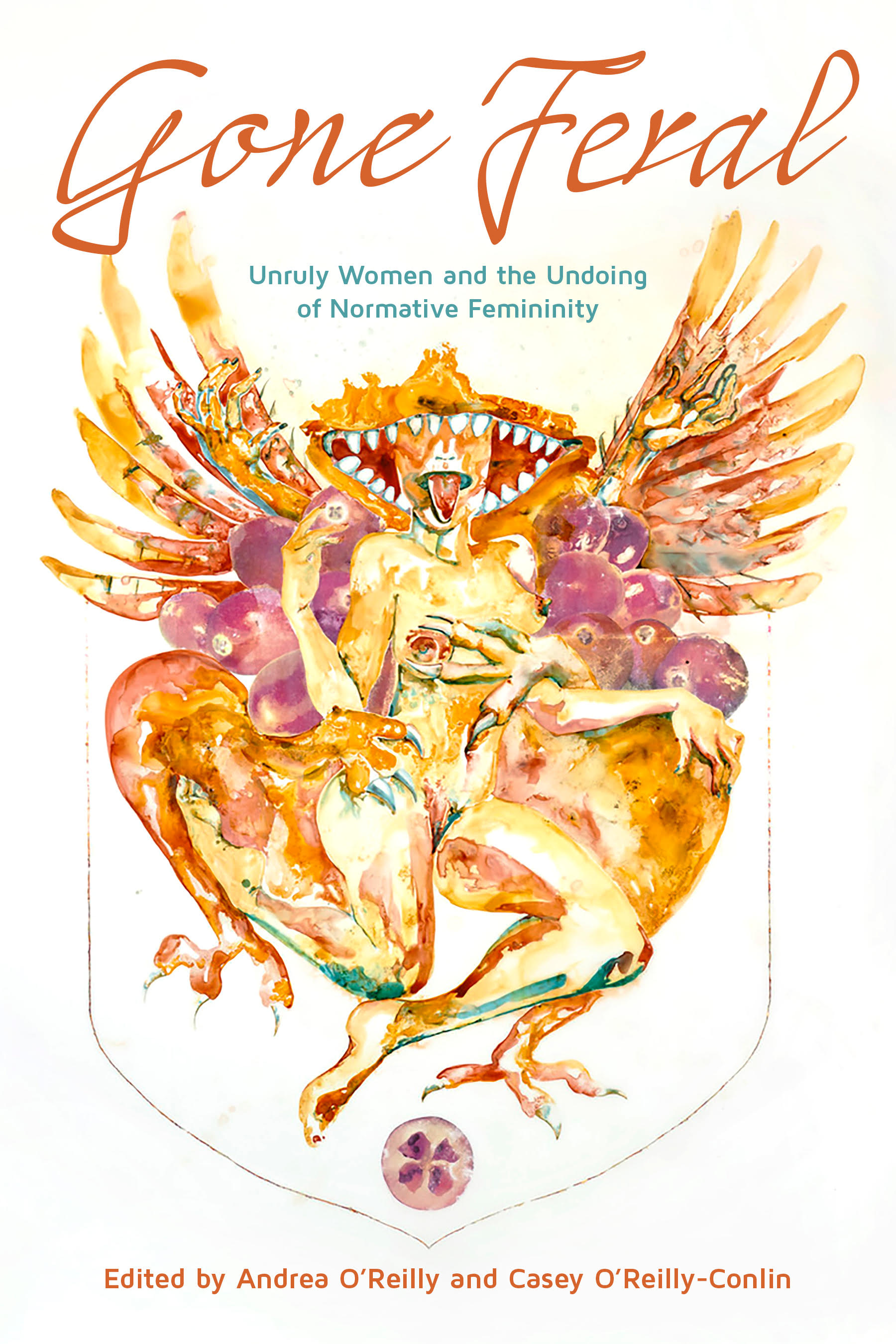
In Materna Sinistra, the image on the
book cover, Carter uses acrylic ink on
transparent drafting film, creating a
sumptuously vulgar winged creature.
Its sharp tongue and talons appear ready
to gnash and gash while plump purple
berries bulge from its backside,
a reference to the artist’s upbringing on
a cranberry farm.
In the section on Representations,
scholar Li Yang discusses feminist Chinese
artist Xiao Lu’s provocative and political
work, arguing “the boundary between
the tamed and the untamed is porous,
dynamic, and often blurred and is shaped
by intricate femininity, womanhood, and
motherhood.”
The entwined nature of these themes
proves ritualistic in Lu’s artistic practice,
bringing outlaw visions into discussion of
what Yang terms “untamed motherhood.”
Later, in an essay on lesbian novelist
Jeanette Winterson, Else Werring notes,
“motherhood has often been deemed
unworthy of academic interest,” illuminat-
ing the collection’s crucial contribution
to the field of motherhood studies.
As Gone Feral makes clear, when
considering themes of feral feminism,
motherhood becomes a powerful
site of exploration. The collection’s
collaborative mother/daughter spirit
opens new pathways of intimacy, offering
transformative work that challenges
gender norms while centering compelling
reflections on matriarchy.
- Review by Alex Hall
Dr. Andrea O’Reilly is internationally recognized as the founder of Motherhood Studies (2006) and its subfield Maternal Theory (2007), and creator of Matricentric Feminism, a feminism for and about mothers (2016) and Matricritics, a literary theory and practice for a reading of mother-focused texts (2021). She is full professor in the School of Gender, Sexuality and Women’s Studies at York University, founder/editor-in-chief of the Journal of the Motherhood Initiative and publisher of Demeter Press. She is co-editor/editor of thirty plus books on many motherhood topics including: Maternal Theory, Feminist Mothering, Young Mothers, Monstrous Mothers, Maternal Regret, Normative Motherhood, Mothers and Sons, Mothers and Daughters, Maternal Texts. Her 2024 titles include Care(ful) Relationships between Mothers and the Caregivers They Hire, The Mother Wave; Theorizing, Enacting, and Representing Matricentric Feminism; and The Missing Mother. She is author of four monographs including Matricentric Feminism: Theory Activism, Practice, the 2nd Edition (2021) and In (M)otherwords; Writings on Mothering and Motherhood, 2009-2024 (2024). She has published 15 chapters on 30 post 2010 novels/memoirs that will soon be published in the monograph Matricritics as Literary Theory and Criticism: Reading the Maternal in Post-2010 Women’s Narratives. She has received more than 1.5 million dollars in funding for her research projects including her current one on Millennial Mothers.
Casey O’Reilly-Conlin Casey O’Reilly-Conlin has a Bachelor’s Degree in Women’s Studies and a Master’s degree in Environmental Studies, both from York University. Much of the research for her chapter in this collection was developed during writing her major research paper for her Master’s degree, entitled The Feline, Feminine, and Familiar: Co-Histories of Domestic Micro-Rebellions, which interrogates the conjoined histories of women and cats in Western culture. She has a passion for all disobedient beings, especially of the feline variety. She embraces “the mystical divinity of unashamed felinity,” a quote from T.S. Elliot’s Old Possum’s Book of Practical Cats, later developed by Andrew Lloyd Webber into the Broadway musical Cats. She resides in Toronto, Ontario with her partner and cat.